ECAT is the entry test for UET Lahore, and it rewards a different kind of strategy from tests without a penalty. Negative marking means every answer is a small decision, and the merit formula means your FSc marks matter more than many students expect. This guide covers both, then lays out a study plan.
What the ECAT looks like
According to the criteria guide our merit calculator is built on, the ECAT has:
- 100 MCQs in 100 minutes, for a total of 400 marks
- Mathematics or Biology: 30 questions
- Physics: 30 questions
- Chemistry or Computer Science: 30 questions
- English: 10 questions
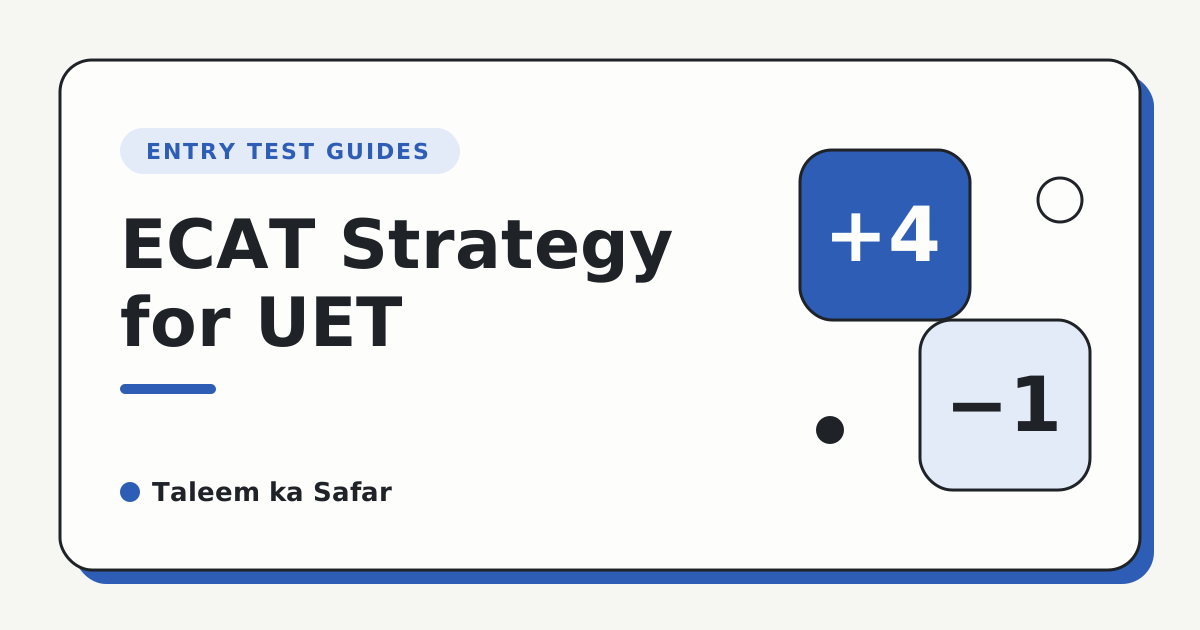
- Negative marking: +4 for a correct answer, −1 for a wrong one
That is one minute per question, which feels comfortable until you meet a long numerical problem. Pacing matters as much as knowledge.
What +4 / −1 negative marking really means
Each question has three possible outcomes: right (+4), wrong (−1) or skipped (0). Your net score is simple to work out. A student with 70 correct, 20 wrong and 10 skipped scores 70 × 4 − 20 × 1 = 260 out of 400.
When is a guess worth it?
Think about the average result of a guess. If your chance of being right is p, the expected marks from answering are:
Expected marks = 4 × p − 1 × (1 − p) = 5p − 1
That number is above zero whenever p is more than 0.2, so answering pays off on average when your chance of being right is better than 1 in 5.
For a question with four options (check the official paper instructions for the actual format):
- Pure blind guess: p = 1/4, so 5 × 0.25 − 1 = +0.25 marks on average.
- One option ruled out: p = 1/3, so about +0.67 marks on average.
- Two options ruled out: p = 1/2, so +1.5 marks on average.
What this means in the exam hall
- If you can rule out even one option, answering is usually the better choice.
- A pure blind guess is only slightly positive on average, and it adds risk. Early in the paper, skip it and come back if time allows.
- Never let one hard question eat two or three minutes. Mark it, move on, return later.
- Practise with the same rule at home, so the habit feels natural on test day.
Remember that the merit formula uses your net score after deductions, so enter that number in any calculator.
Why FSc matters so much at UET Lahore
The UET Lahore formula gives ECAT 33%, FSc 50% and Matric 17%. ECAT is out of 400, FSc and Matric out of 1100. Academics together make up 67% of the aggregate.
Here is a hypothetical example (made-up marks):
| Part | Fraction | × Weight | Points |
|---|---|---|---|
| ECAT | 260 ÷ 400 = 0.65 | × 33 | 21.45 |
| FSc | 990 ÷ 1100 = 0.90 | × 50 | 45.00 |
| Matric | 1045 ÷ 1100 = 0.95 | × 17 | 16.15 |
| Aggregate | 82.60 |
Each correct ECAT answer (4 marks) adds 4 ÷ 400 × 33 = 0.33 points. Every 10 FSc marks add 10 ÷ 1100 × 50 ≈ 0.45 points. If you are still in FSc Part 2, your board exams are part of your ECAT strategy.
There is also an eligibility rule: our source lists a minimum of 60% unadjusted marks in FSc for UET Lahore (a PEC rule). Domicile restrictions apply to specific seats, while open-merit seats are also available.
Our source guide does not state which admission year this formula applies to, and formulas change between sessions. Verify the current criteria with the official UET Lahore admission notification before you apply.
A phased ECAT study plan
Phase 1: Foundations
- Take one timed baseline paper and note your accuracy per subject, not just your score.
- Revise FSc Mathematics (or Biology), Physics and Chemistry chapter by chapter.
- Learn the key formulas and units until you can write them from memory.
Phase 2: Accuracy under a penalty
- Practise chapter-wise sets and track how many answers were wrong, not only right.
- After every set, sort your mistakes into concept gaps, careless slips and bad guesses.
- Spend a few minutes daily on English grammar and vocabulary. Those 10 questions still count for 40 marks.
Phase 3: Exam simulation
- Take full 100-question papers in 100 minutes, with the +4/−1 rule applied.
- Use a two-pass approach: answer what you know first, then return to the questions you marked.
- Review each paper the next day, then practise the chapters that cost you the most marks.
Our guide on how to use mock tests effectively goes deeper into reviewing papers and avoiding burnout.
ECAT on Taleem ka Safar
ECAT practice on Taleem ka Safar is coming soon. If you are also sitting NET or a Punjab University test, chapter-wise practice and past papers for both are live today, and timed mock tests are live for NET (PU mocks are coming soon). See our NUST NET preparation guide for that plan.
Estimate your UET Lahore aggregate
Try different ECAT and FSc scores in the UET Lahore merit calculator to see which one moves your aggregate more. To compare UET with other universities, open the full merit calculator or read how university merit is calculated in Pakistan.
Create your free Taleem ka Safar account (free for students) to start practising, and keep an eye out for ECAT practice when it launches.